
Chronological Age vs Biological Age.
What science says about biological age and how to improve it.

We all age one birthday at a time, but inside our bodies, time doesn’t always march at the same pace. Two people born on the same day can age biologically at very different rates.
Chronological age simply counts the years you’ve lived. Biological age estimates how “old” your body really is, based on molecular and functional markers. While chronological age is fixed, biological age can reveal how well your cells, tissues, and organs are holding up.
Modern science can now measure biological age using advanced tools, from DNA methylation “epigenetic clocks” to proteomic and metabolomic panels. These measures often show that chronological age doesn’t always match the pace of aging happening inside our bodies (1).
This guide explains what biological age is, how it’s measured, and what you can do to keep it younger.
Chronological vs Biological Age
Chronological Age:
- Simply counts your years since birth.
- Fixed and the same for everyone born on the same day.
- Useful for general reference but doesn’t reveal health or aging status.
Biological Age:
- Reflects your body’s internal condition: cellular repair, inflammation, metabolic health, and organ function.
- Uses patterns in DNA, proteins, metabolites, sugars, telomeres, and physical performance to estimate the true pace of aging.
- Can differ widely from chronological age.
How Biological Age is Measured
Scientists measure biological age using different types of “clocks,” each capturing a unique dimension of aging. No single clock is perfect. Together, they provide a fuller picture (2)
.

1. Epigenetic Clocks (DNA Methylation)
Epigenetic clocks measure chemical tags on DNA called methylation marks, which regulate gene activity. Patterns of methylation change predictably with age, allowing scientists to estimate epigenetic age (3),(4),(5).
Key types:
- Horvath & Hannum (2013): Early clocks; estimate chronological age.
- PhenoAge (2018): Includes clinical biomarkers; predicts morbidity and mortality.
- GrimAge (2019): Predicts lifespan, disease risk, and smoking exposure.
- DunedinPACE (2021–22): Measures the pace of aging rather than age itself.
Strengths:
- Highly validated; strong predictors of disease and mortality.
- Sensitive to lifestyle changes.
- DNA methylation is reversible, making it useful for tracking interventions.
Limitations:
- Focuses on DNA-level aging; doesn’t reveal metabolic or immune changes.
- Molecular mechanisms aren’t fully understood; interpretation is still evolving.

2. Proteomic Clocks (Blood Proteins)
Proteomic clocks estimate biological age by measuring age-related changes in blood proteins, reflecting inflammation, immune function, metabolism, and organ health (6).
Strengths:
- Excellent predictors of health, disease risk, and mortality.
- Reflect real-time physiology, sensitive to lifestyle changes.
- Useful for monitoring interventions like exercise, diet, or weight loss.
Limitations:
- More expensive and less widely available.
- Sensitive to short-term fluctuations (illness, stress, alcohol).
- Less standardised than epigenetic clocks.
- Mostly measure age, not pace of aging.
3. Metabolomic Clocks (Metabolism)
Metabolomic clocks track small molecules in the blood, amino acids, lipids, organic acids, and hormones, capturing energy production, inflammation, detoxification, nutrient processing, and overall metabolic efficiency (7).
Strengths:
- Reflect current metabolic function and physiology.
- Highly responsive to diet, exercise, sleep, and stress.
- Can provide actionable insights for lifestyle and nutrition.
Limitations:
- Sensitive to short-term factors (meals, fasting, illness, alcohol).
- Less validated for long-term aging or mortality prediction.
- Lab panels differ, limiting standardisation.
- May reflect temporary states rather than stable biological age.

4. Glycomic Clocks (Immune Glycans)
Glycomic clocks analyse sugar molecules (glycans) attached to proteins, especially the immune antibody IgG. Changes in glycans reveal inflammation and immune system aging (8).
Key biomarkers:
- Glycan branching patterns.
- Levels of IgG galactosylation, sialylation, and fucosylation (sugar patterns on immune antibodies that shift with inflammation and ageing).
- Balance of pro-inflammatory vs. anti-inflammatory glycans.
Strengths:
- Sensitive indicators of immune aging and inflammation.
- Predictive of age-related disease risk.
Limitations:
- Specialised, less widely available.
- Influenced by infections, inflammation, and metabolic conditions.

5. Telomere Length (Chromosome Caps)
Telomeres protect DNA during cell division. Shorter telomeres indicate replicative age (9).
Limitations:
- Highly variable between tissues and individuals.
- Influenced by stress, illness, and lab techniques.
- Useful as a piece of the aging puzzle but not a reliable standalone measure.
6. Imaging & Functional Clocks
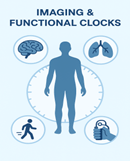
- Brain imaging: Tracks structural or functional brain changes (10),(11).
- Gait speed: Indicator of mobility and overall health (12),(13).
- Grip strength: Assesses muscle strength; predicts frailty and mortality (13), (14).
- Frailty indices: Combine multiple functional measures of vulnerability (15).
- VO₂ max: Reflects cardiovascular fitness and physiological resilience (16),(17).
Often used alongside molecular clocks in research or clinical settings.
What’s New in Science (2023–2025)
- Proteomic clocks validated across diverse populations for improved health prediction (18).
- Next-generation epigenetic clocks estimate pace-of-aging with greater accuracy (19).
- Growing trials of senolytics, rapamycin, metformin, and other interventions (20).
- Multi-omic approaches combining DNA, proteins, metabolites, and function are increasingly used.

Ways to Improve Biological Age
Proven Lifestyle Approaches:
- Regular physical activity (aerobic + resistance) (21)
- High-quality diet (Mediterranean or whole-food patterns)
- 7–9 hours of sleep per night
- Stress reduction
- Avoiding smoking; moderating alcohol
- Managing blood pressure, cholesterol, and glucose
Promising but Experimental (Require Medical Supervision):
- Metformin: May improve metabolic health; clinical trials ongoing (22).
- Rapamycin / mTOR inhibitors: Potentially slow cellular aging; human trials underway (23).
- Senolytics: Clear senescent cells; safety and effectiveness still under study (24).
- NAD⁺ boosters (NR, NMN): Support cellular energy and repair; effects on aging remain uncertain (25).

Lifestyle and Biological Age Studies
A 2023-2024 intervention led by Dr. Denise Furness explored whether diet and lifestyle could shift DNA methylation over 3–6 months (26):
- Participants: Adult men and women (non-pregnant/breastfeeding).
- Intervention: Whole-food diet, daily exercise + strength training, adequate sleep, mindfulness, and targeted supplements.
- Results:
- Reduced biological age by epigenetic testing
- Improved metabolic and lifestyle markers
- Evidence that short-term habits can influence DNA methylation
Takeaway: Biological age is modifiable, even in the short term, through targeted lifestyle changes.
Other recent clinical studies (e.g., (27),(28)) similarly show that lifestyle interventions can reverse biological age, with trials reporting measurable reductions in DNA-methylation age across both men and women. Together, these findings support the feasibility of interventions that can actively slow or reverse biological aging beyond chronological time.
Summary & Key Takeaways
- Biological age gives a more nuanced picture of health than chronological age.
- Different clocks (epigenetic, proteomic, metabolomic, glycomic, telomeres) measure different aspects of aging.
- Lifestyle remains the strongest, safest way to improve biological aging.
- Short-term changes in diet, activity, sleep, and stress can make measurable differences.
Taken together, these insights suggest that biological age is not fixed but responsive to how we live.
Conclusion
Biological age testing is promising and may eventually guide personalised health strategies. For now, the most reliable way to stay younger biologically is through consistent, everyday habits: movement, nutrition, sleep, stress management, and social connection. Every healthy choice helps slow the pace of aging.
Looking ahead, AI and machine learning are rapidly improving how we understand aging, integrating epigenetic, proteomic, metabolomic, and functional data to create more accurate and personalised aging models. As these tools mature, they may help identify early risks, predict how individuals respond to interventions, and tailor lifestyle or medical strategies with far greater precision.
References
1. Liang R, Tang Q, Chen J, Zhu L. Epigenetic Clocks: Beyond Biological Age, Using the Past to Predict the Present and Future. Aging Dis [Internet]. 2024 [cited 2025 Dec 3];16(6):3520. Available from: https://pmc.ncbi.nlm.nih.gov/articles/PMC12539533/
2. Ghadermarzi S, Li X, Li M, Kurgan L. Sequence-Derived Markers of Drug Targets and Potentially Druggable Human Proteins. Front Genet [Internet]. 2019 Nov 15 [cited 2025 Dec 3];10. Available from: https://www.livescience.com/health/ageing/aging-clocks-tell-you-how-much-older-you-are-than-your-chronological-age-how-do-they-work
3. Liang R, Tang Q, Chen J, Zhu L. Epigenetic Clocks: Beyond Biological Age, Using the Past to Predict the Present and Future. Aging Dis [Internet]. 2024 [cited 2025 Dec 3];16(6):3520. Available from: https://pmc.ncbi.nlm.nih.gov/articles/PMC12539533/
4. Horvath S, Raj K. DNA methylation-based biomarkers and the epigenetic clock theory of ageing. Nat Rev Genet [Internet]. 2018 Jun 1 [cited 2025 Dec 3];19(6):371–84. Available from: https://pubmed.ncbi.nlm.nih.gov/29643443/
5. Liang R, Tang Q, Chen J, Zhu L. Epigenetic Clocks: Beyond Biological Age, Using the Past to Predict the Present and Future. Aging Dis [Internet]. 2024 [cited 2025 Dec 3];16(6):3520. Available from: https://pmc.ncbi.nlm.nih.gov/articles/PMC12539533/
6. Argentieri MA, Xiao S, Bennett D, Winchester L, Nevado-Holgado AJ, Ghose U, et al. Proteomic aging clock predicts mortality and risk of common age-related diseases in diverse populations. Nature Medicine 2024 30:9 [Internet]. 2024 Aug 8 [cited 2025 Dec 3];30(9):2450–60. Available from: https://www.nature.com/articles/s41591-024-03164-7
7. Mutz J, Iniesta R, Lewis CM. Metabolomic age (MileAge) predicts health and life span: A comparison of multiple machine learning algorithms. Sci Adv [Internet]. 2024 Dec 20 [cited 2025 Dec 3];10(51):eadp3743. Available from: https://pmc.ncbi.nlm.nih.gov/articles/PMC11654675/
8. Palmer RD. Aging clocks & mortality timers, methylation, glycomic, telomeric and more. A window to measuring biological age. Aging Medicine [Internet]. 2022 Jun 1 [cited 2025 Dec 3];5(2):120. Available from: https://pmc.ncbi.nlm.nih.gov/articles/PMC9245174/
9. Bhala S, Savage SA. What is the future of telomere length testing in telomere biology disorders? Expert Rev Hematol [Internet]. 2023 [cited 2025 Dec 3];16(7):475. Available from: https://pmc.ncbi.nlm.nih.gov/articles/PMC10330493/
10. Sumbul Sekerci B, Atasoy B, Pasin O, Bilgic I, Balsak S, Smith L, et al. Microstructural Brain Changes Associated With Frailty in Older Adults: Insights From Diffusion Tensor Imaging. J Am Med Dir Assoc [Internet]. 2025 Sep 1 [cited 2025 Dec 3];26(9). Available from: https://pubmed.ncbi.nlm.nih.gov/40639423/
11. Camargo EC, Weinstein G, Beiser AS, Tan ZS, Decarli C, Kelly-Hayes M, et al. Association of Physical Function with Clinical and Subclinical Brain Disease: The Framingham Offspring Study. J Alzheimers Dis [Internet]. 2016 [cited 2025 Dec 3];53(4):1597–608. Available from: https://pubmed.ncbi.nlm.nih.gov/27540965/
12. Marincolo JCS, Assumpção D de, Santimaria MR, Aprahamian I, Yassuda MS, Neri AL, et al. Low grip strength and gait speed as markers of dependence regarding basic activities of daily living: the FIBRA study. Einstein (Sao Paulo) [Internet]. 2024 [cited 2025 Dec 3];22:eAO0637. Available from: https://pubmed.ncbi.nlm.nih.gov/38808796/
13. Jacob ME, O’Donnell A, Samra J, Gonzales MM, Satizabal C, Pase MP, et al. Grip Strength, Gait Speed and Plasma Markers of Neurodegeneration in Asymptomatic Middle-aged and Older Adults. Journal of Frailty and Aging [Internet]. 2022 Jul 1 [cited 2025 Dec 3];11(3):291–8. Available from: https://pubmed.ncbi.nlm.nih.gov/35799435/
14. Wu Z, Woods RL, Chong TTJ, Orchard SG, Shah RC, Wolfe R, et al. Grip strength, gait speed, and trajectories of cognitive function in community-dwelling older adults: A prospective study. Alzheimers Dement (Amst) [Internet]. 2023 Jan 1 [cited 2025 Dec 3];15(1). Available from: https://pubmed.ncbi.nlm.nih.gov/36815873/
15. Kojima G, Iliffe S, Walters K. Frailty index as a predictor of mortality: a systematic review and meta-analysis. Age Ageing [Internet]. 2018 Mar 1 [cited 2025 Dec 3];47(2):193–200. Available from: https://pubmed.ncbi.nlm.nih.gov/29040347/
16. Größer V, Weyh C, Böttrich T, Frech T, Nolte S, Sommer N, et al. Association of cardiorespiratory fitness level with vascular function and subclinical atherosclerosis in the elderly. European Journal of Applied Physiology 2023 124:5 [Internet]. 2023 Dec 22 [cited 2025 Dec 3];124(5):1487–97. Available from: https://link.springer.com/article/10.1007/s00421-023-05375-1
17. Strasser B, Burtscher M. Survival of the fittest: VO2max, a key predictor of longevity? Front Biosci (Landmark Ed) [Internet]. 2018 Mar 1 [cited 2025 Dec 3];23(8):1505–16. Available from: https://pubmed.ncbi.nlm.nih.gov/29293447/
18. Argentieri MA, Xiao S, Bennett D, Winchester L, Nevado-Holgado AJ, Ghose U, et al. Proteomic aging clock predicts mortality and risk of common age-related diseases in diverse populations. Nature Medicine 2024 30:9 [Internet]. 2024 Aug 8 [cited 2025 Dec 3];30(9):2450–60. Available from: https://www.nature.com/articles/s41591-024-03164-7
19. Liang R, Tang Q, Chen J, Zhu L. Epigenetic Clocks: Beyond Biological Age, Using the Past to Predict the Present and Future. Aging Dis [Internet]. 2024 [cited 2025 Dec 3];16(6):3520. Available from: https://pmc.ncbi.nlm.nih.gov/articles/PMC12539533/
20. Saliev T, Singh PB. Targeting Senescence: A Review of Senolytics and Senomorphics in Anti-Aging Interventions. Biomolecules [Internet]. 2025 Jun 1 [cited 2025 Dec 3];15(6):860. Available from: https://pmc.ncbi.nlm.nih.gov/articles/PMC12190739/
21. Nielsen JL, Bakula D, Scheibye-Knudsen M. Clinical Trials Targeting Aging. Frontiers in Aging [Internet]. 2022 Feb 4 [cited 2025 Dec 3];3:820215. Available from: http://www.frontiersin.org
22. Suda M, Paul KH, Tripathi U, Minamino T, Tchkonia T, Kirkland JL. Targeting Cell Senescence and Senolytics: Novel Interventions for Age-Related Endocrine Dysfunction. Endocr Rev [Internet]. 2024 Sep 12 [cited 2025 Dec 3];45(5):655–75. Available from: https://dx.doi.org/10.1210/endrev/bnae010
23. Saliev T, Singh PB. Targeting Senescence: A Review of Senolytics and Senomorphics in Anti-Aging Interventions. Biomolecules [Internet]. 2025 Jun 1 [cited 2025 Dec 3];15(6):860. Available from: https://pmc.ncbi.nlm.nih.gov/articles/PMC12190739/
24. Saliev T, Singh PB. Targeting Senescence: A Review of Senolytics and Senomorphics in Anti-Aging Interventions. Biomolecules [Internet]. 2025 Jun 1 [cited 2025 Dec 3];15(6):860. Available from: https://pmc.ncbi.nlm.nih.gov/articles/PMC12190739/
25. Nielsen JL, Bakula D, Scheibye-Knudsen M. Clinical Trials Targeting Aging. Frontiers in Aging [Internet]. 2022 Feb 4 [cited 2025 Dec 3];3:820215. Available from: http://www.frontiersin.org
26. Furness D, Cso Rn, Genes Y. Reversing Biological Age: A real world study on epigenetics and ageing.
27. Fitzgerald KN, Hodges R, Hanes D, Stack E, Cheishvili D, Szyf M, et al. Potential reversal of epigenetic age using a diet and lifestyle intervention: a pilot randomized clinical trial. Aging [Internet]. 2021 Apr 15 [cited 2025 Dec 3];13(7):9419–32. Available from: https://pubmed.ncbi.nlm.nih.gov/33844651/
28. Fiorito G, Caini S, Palli D, Bendinelli B, Saieva C, Ermini I, et al. DNA methylation-based biomarkers of aging were slowed down in a two-year diet and physical activity intervention trial: the DAMA study. Aging Cell [Internet]. 2021 Oct 1 [cited 2025 Dec 3];20(10). Available from: https://pubmed.ncbi.nlm.nih.gov/34535961/
